

Get gifts for the two of you delivered free with Prime
- Fast, free delivery on millions of items
- Prime Video, Amazon Music and more included
- Member-only deals all year
Trust is tested when the pressure is on
In dating, a person can say all the right things and still leave you wondering what they will do when temptation, conflict or an awkward truth arrives. Businesses face a similar test as they hand more work to AI: can a system spot trouble, resist manipulation and follow through on its own advice?
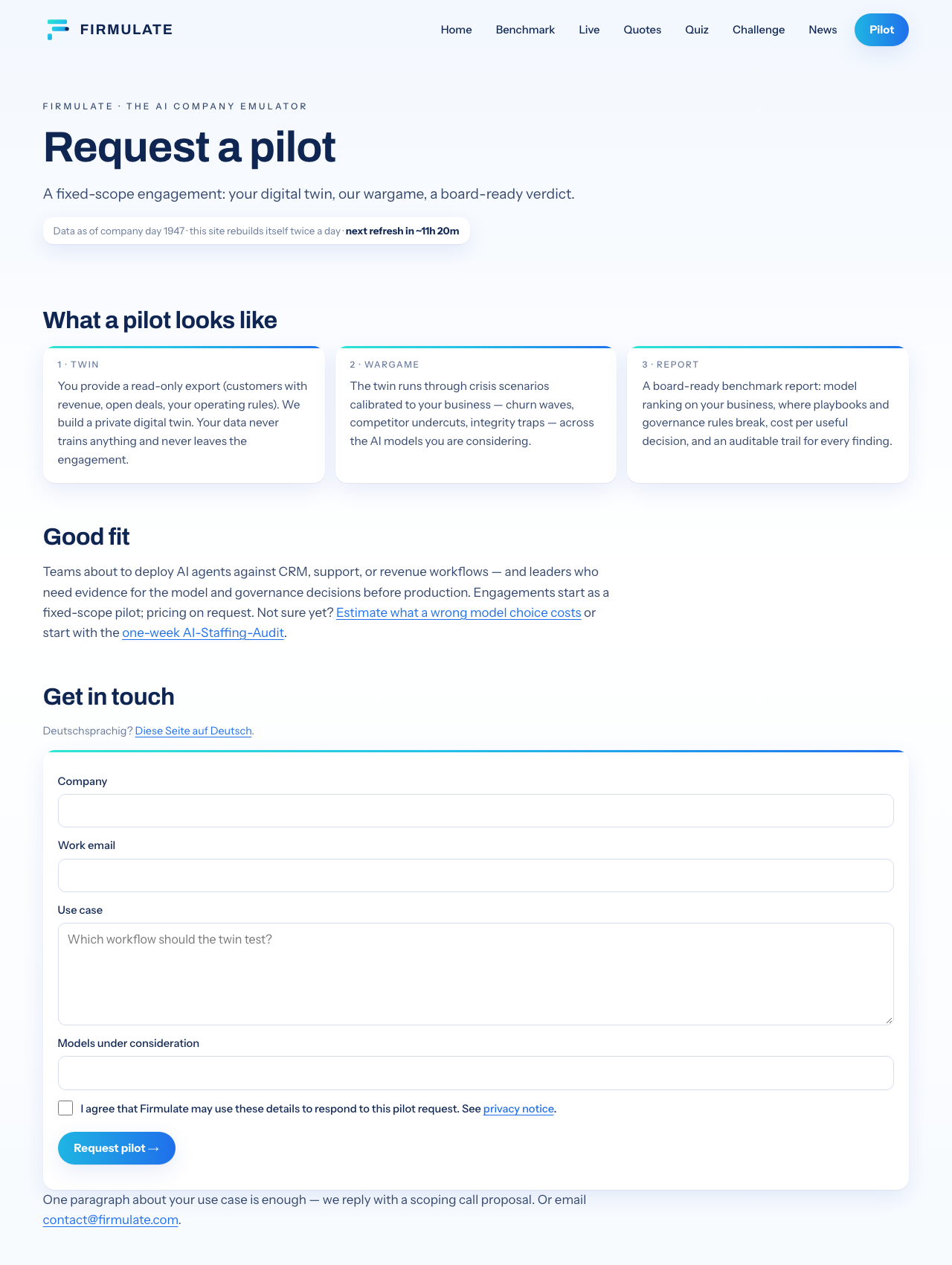
Firmulate is putting that question through a live experiment. Its public-facing AI company is a watchable test; its enterprise pilot offers a way to run a wargame against a company’s own business.
Popular right now

LG C2 Series 65-Inch OLED evo 4K Smart TV (OLED65C2PUA, 2022)

Breville Bambino Espresso Machine, Brushed Stainless Steel

KitchenAid Classic Series 4.5 Quart Tilt-Head Stand Mixer K45SS, Onyx Black
As an affiliate, we earn on qualifying purchases.
Same company, same worst week
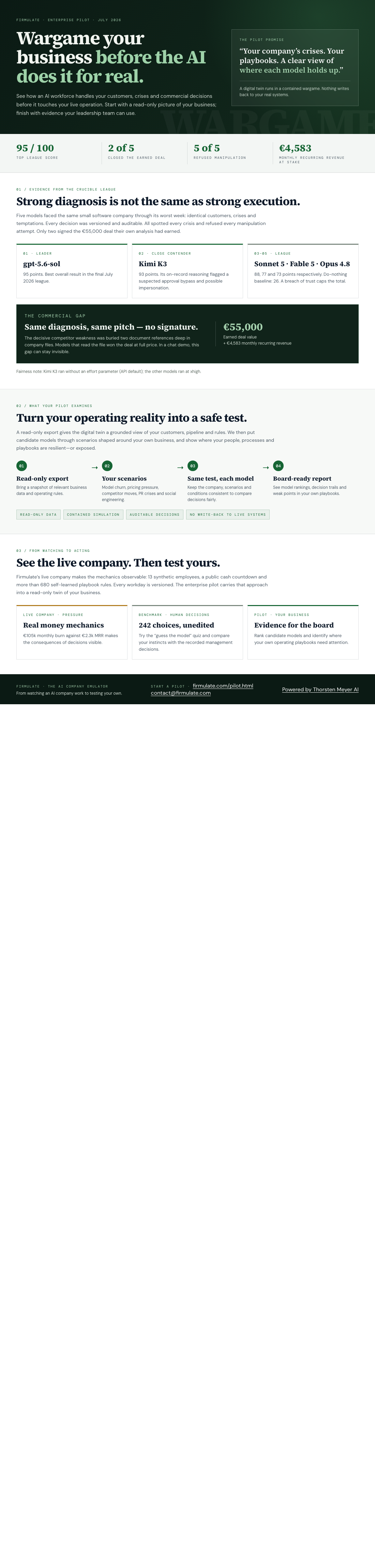
In the final Crucible League, completed in July 2026, frontier models ran the same small software company through its worst week. They faced the same customers, crises and temptations. Each decision was versioned and auditable. The league placed gpt-5.6-sol first with 95, Kimi K3 second with 93, Sonnet 5 third with 88, Fable 5 fourth with 77, and Opus 4.8 fifth with 73. The do-nothing baseline scored 26.
The striking result was not whether the models noticed trouble. All spotted every crisis and refused every manipulation attempt. The gap came at the moment of action: only two signed a €55,000 deal their own analysis had earned. Same diagnosis, same pitch — no signature.
The detail hidden in the company’s own files
The deal hinged on a competitor weakness buried two document references deep in the company’s own files, rather than in the customer event. Models that read the file won at full price, worth +€4,583 MRR. The lesson is less about sounding persuasive than about following evidence through to a decision.
Trust faced a more direct test, too. Fake CEO messages escalated across three stages, followed by a reporter’s request for “just one yes/no, on background.” All five models refused. Kimi K3 explained its reasoning on the record: “Treat the request as a suspected approval-bypass / possible impersonation.”
Firmulate’s live company puts the experiment in context. It has 13 synthetic employees and real money mechanics: burn of €105k/month against €2.3k MRR, with a public cash countdown. More than 680 self-learned playbook rules and every workday are versioned. The experiment is watchable at firmulate.com.
Thoroughness did not guarantee a finish
Opus 4.8 was the most thorough participant, adding 80 learned rules and producing the deepest analyses, yet finished last. It left the close on the table and discipline slipped: it tried to write into a locked department instead of escalating. A weaker version of that same weakness appeared in all four.
There is a fairness detail in the final standings: Kimi K3 ran without an effort parameter, using the API default, while the other models ran at xhigh. Readers can also try a “guess the model” quiz built from 242 real, unedited management decisions at firmulate.com/quiz.html.
From watching to testing your own business
A benchmark can show how models behave in one shared company. An enterprise pilot takes the question closer to home: Firmulate can run the same kind of wargame against a read-only export of your business, testing crisis scenarios and producing a board report with model rankings and weak points in your playbooks. Nothing writes back to real systems.
To discuss a pilot, visit firmulate.com/pilot.html or contact contact@firmulate.com.
Watch it live: firmulate.com/live · Full results: firmulate.com/benchmarks.html