
Tales Couples Edition is my best overall pick for couples dinner party games because its 150 conversation cards offer plenty of prompts for a shared table. For lighter, faster play, After Dinner Amusements: Which Would You Choose? brings quick dilemmas, while Food Decision Dice gives indecisive diners a playful way to choose what comes next. The main tradeoff is between meaningful conversation and easy laughs: deeper questions can feel personal with newer friends, while quick games may offer less room for connection. Group size, comfort with adult humor, and how much attention guests can spare also affect the fit. Read on for the full comparison and advice on choosing a game that suits your dinner party.

Get gifts for the two of you delivered free with Prime
- Fast, free delivery on millions of items
- Prime Video, Amazon Music and more included
- Member-only deals all year
Key Takeaways
- Tales Couples Edition leads this roundup for its large prompt deck, while Get Closer offers a smaller, more focused set for hosts who want a compact conversation starter.
- Conversation games vary by intimacy: Let’s Get Deep and We’re Not Really Strangers Couples Edition suit groups ready for personal prompts, while TableTopics Original is a more flexible choice for mixed company.
- Quick-play options such as Which Would You Choose?, Food Decision Dice, and Incohearent ask for less sustained attention than question-card decks.
- Dirty Minds and Not Your Mom’s Dinner Party lean toward adult humor, so their appeal depends more on the guests’ comfort level than on a universal idea of party fun.
- The lineup includes games beyond conversation cards: I Should Have Known That! adds trivia, Who’s Most Likely To… invites group voting, and Food Decision Dice turns a dinner decision into play.
| Tales Couples Edition: 150 Conversation Cards | 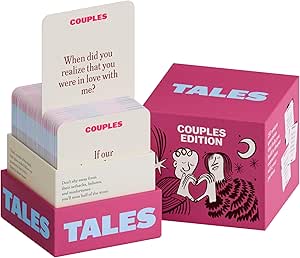 | Best for Teen Couples | Card count: 150 | Edition: Couples Edition | Intended audience: Teenagers | VIEW LATEST PRICE | See Our Full Breakdown |
| TDC Games Dirty Minds Travel Card Game for Adults |  | Best for Playful Adult Groups | Game type: Card game | Players: 2 or more | Age guidance: 17+ | VIEW LATEST PRICE | See Our Full Breakdown |
| Food Decision Dice for Date Nights |  | Best for Choosing Dinner | Brand: kykake | Model: F-001 | Material: Beech wood | VIEW LATEST PRICE | See Our Full Breakdown |
| TableTopics Original Conversation Cards for Adults |  | Best for Couples Hosting a Group | Brand: TableTopics | Model: Original | Question count: 135 | VIEW LATEST PRICE | See Our Full Breakdown |
| We’re Not Really Strangers Couples Edition Conversation Card Game |  | Best for Deeper Couple Conversations | Players: 2 | Recommended age: 15 years and up | Card count: 150 | VIEW LATEST PRICE | See Our Full Breakdown |
| After Dinner Amusements: Which Would You Choose? — 50 Amusing Dilemmas |  | Best Compact Icebreaker | Brand: Chronicle Books | Cards: 50 trivia cards | Recommended age: 8 years and up | VIEW LATEST PRICE | See Our Full Breakdown |
| Who’s Most Likely To… Kinda Clean Edition Family Card Game |  | Best for Lively Groups | Brand: DSS Games | Game type: Party card game | Cards: 250 prompt cards | VIEW LATEST PRICE | See Our Full Breakdown |
| I Should Have Known That! Trivia Game, Green |  | Best for Trivia-Loving Couples | Brand: Hygge Games | Model: 21026 | Color: Green | VIEW LATEST PRICE | See Our Full Breakdown |
| We’re Not Really Strangers Conversation Card Game |  | Best for Reflective Group Conversation | Players: 2–6 | Recommended age: 15 years and up | Cards: 150 conversation cards and wildcards | VIEW LATEST PRICE | See Our Full Breakdown |
| Let’s Get Deep: A Question Card Game for Couples |  | Best for Couples Who Want More Intimate Prompts | Brand: WHAT DO YOU MEME? | Cards: 200 | Categories: Ice Breaker, Deep, Deeper, Activity | VIEW LATEST PRICE | See Our Full Breakdown |
| Intelligent Change Get Closer Conversation Cards: 52 Dinner Party and Icebreaker Questions |  | Best for Mixed Groups | Brand: Intelligent Change | Game type: Conversation card game | Number of cards: 52 | VIEW LATEST PRICE | See Our Full Breakdown |
| Incohearent: Guess the Gibberish Party Game |  | Best for Laugh-Out-Loud Group Play | Brand: Relatable | Game type: Gibberish phrase-guessing card game | Players: 3–8 | VIEW LATEST PRICE | See Our Full Breakdown |
| The Couples Game That’s Actually Fun: Date Night Card Game |  | Best for Couples Who Like Playful Competition | Brand: DSS Games | Game type: Couples conversation card game | Number of cards: 150 | VIEW LATEST PRICE | See Our Full Breakdown |
| Talking Hearts Couples Conversation Cards – 200 Questions and 2 Wild Cards |  | Best for Two-Person Date Night | Brand: Talking Hearts | Edition: Couples Edition | Included components: 101 cards | VIEW LATEST PRICE | See Our Full Breakdown |
| TableTopics Not Your Mom’s Dinner Party Conversation Cards for Adults |  | Best for Adult-Only Dinner Parties | Brand: TableTopics | Game type: Conversation party game | Number of questions: 135 | VIEW LATEST PRICE | See Our Full Breakdown |
| couples dinner party game | Players | Brand | Recommended age | Material |
|---|---|---|---|---|
| Tales Couples Edition: 150 Con | — | — | — | — |
| TDC Games Dirty Minds Travel C | 2 or more | — | — | Paper |
| Food Decision Dice for Date Ni | — | kykake | — | Beech wood |
| TableTopics Original Conversat | 2–20 | TableTopics | 12 years and up | — |
| We’re Not Really Strangers Cou | 2 | — | 15 years and up | Cardstock |
| After Dinner Amusements: Which | — | Chronicle Books | 8 years and up | Paper |
| Who’s Most Likely To… Kinda | 4 or more | DSS Games | 14 years and up | Cardstock |
| I Should Have Known That! Triv | More than 2 | Hygge Games | 14 years and up | — |
| We’re Not Really Strangers Con | 2–6 | — | 15 years and up | Cardstock |
| Let’s Get Deep: A Question Car | 2 players; can also be played with friends or other couples | WHAT DO YOU MEME? | 17 years and up | Paper |
| Intelligent Change Get Closer | 2–99 | Intelligent Change | 10 years and up | Cardstock and paper |
| Incohearent: Guess the Gibberi | 3–8 | Relatable | 17+ | — |
| The Couples Game That’s Actual | 2 or more | DSS Games | 14 years and up | Cardstock |
| Talking Hearts Couples Convers | — | Talking Hearts | — | — |
| TableTopics Not Your Mom’s Din | 2–20 | TableTopics | 21 years and up | — |
More Details on Our Top Picks
Tales Couples Edition: 150 Conversation Cards
Tales Couples Edition is the best fit here for younger couples who want an easy way to start talking without jumping straight into intense relationship questions. Its 150 prompts span school, friendships, hobbies, goals, and everyday life, giving a couple plenty of approachable topics to draw from over dinner. Compared with We’re Not Really Strangers Couples Edition, this deck is oriented more toward teen experiences than layered reflection, so it may feel less personal to adults. That focus is also its main tradeoff: the subject matter may not fit older couples or a mixed-age dinner party, despite the couples framing. The compact, durable format suits casual gatherings and travel, but the description does not specify rules or a competitive structure; expect conversation starters, not a scored game.
Pros:- Provides 150 prompts across school, friendships, hobbies, goals, and everyday experiences.
- Teen-oriented topics can feel familiar and accessible to younger couples.
- Compact, durable design is convenient to bring to gatherings.
- Works as a conversation starter for game nights and other occasions.
Cons:- Teen-life subject matter may not resonate with adult couples.
- The couples framing may not suit every group or dinner-party format.
- No competitive rules or scoring system are specified.
Best for: Teen couples who want relatable prompts for a relaxed dinner or casual game night.
Not ideal for: Adult couples or mixed-age dinner parties looking for mature, relationship-focused questions.
- Card count:150
- Edition:Couples Edition
- Intended audience:Teenagers
- Topics:School, friendships, hobbies, goals, and everyday experiences
- Design:Compact and durable
- Suggested uses:Game nights, parties, and time together
Our verdict“Choose this deck for teen couples who want broad, low-pressure prompts, but skip it if you need questions aimed at adult relationships.”
TDC Games Dirty Minds Travel Card Game for Adults
Dirty Minds brings more guessing and laughter to dinner than the conversation-led decks in this lineup. Players interpret double-meaning clues to identify ordinary, non-suggestive answers, making it a playful choice for couples who enjoy wordplay and teasing each other. Its rules support two or more players, so it can work for a pair or expand to a table of guests; that flexibility gives it a livelier party role than the two-player We’re Not Really Strangers Couples Edition. The tradeoff is that it is not designed to deepen a couple’s conversation: it asks players to read clues aloud and solve them instead. With 112 cards, including separate clue and scoring cards, it offers a more structured game than a prompt deck, but the adult age guidance and suggestive clue style make it a poor match for family dinners or reserved guests.
Pros:- Double-meaning clues create a guessing game with ordinary answers.
- Supports two or more players, so it can include dinner guests.
- Separate clue and scoring cards give rounds a clear structure.
- Portable box is easy to pack for travel or a gathering.
Cons:- Intended for adult players ages 17 and up.
- Players need to read clues aloud and work out the answers, which may not suit a quiet meal.
- Focuses on wordplay rather than couple-focused conversation.
Best for: Adult couples hosting friends who want a portable, clue-based game with a cheeky tone.
Not ideal for: Family or mixed-age dinners, and couples seeking meaningful relationship questions rather than wordplay.
- Game type:Card game
- Players:2 or more
- Age guidance:17+
- Card count:112
- Card breakdown:56 clue cards and 56 scoring cards
- Box dimensions:7.4 x 4 x 1 inches
- Item weight:4.8 ounces
- Material:Paper
- Included components:Cards
Our verdict“Pick Dirty Minds when your adult dinner table wants an interactive guessing game, not a relationship conversation deck.”
Food Decision Dice for Date Nights
Food Decision Dice takes a different route from the question decks: it helps a couple settle what to eat, rather than providing a full conversation game. Its 12 engraved options—from pizza and sushi to Thai food and steak—turn a familiar decision into a quick, playful roll. Compared with TableTopics Original Conversation Cards, this is far simpler and less suited to keeping a dinner-party discussion going, but it may be more useful when indecision is the evening’s main obstacle. The beech wood die is compact, and its engraved text is intended to stay legible, while the included gift box makes storage straightforward. The limitation is fixed choice: a roll cannot account for allergies, dietary needs, availability, or a craving outside the printed options. I’d treat it as a date-night decision aid, not the centerpiece of a hosted game night.
Pros:- Offers 12 food choices to help break dinner indecision.
- Engraved lettering and patterns are designed to remain easy to read.
- Compact beech wood construction is simple to carry and store.
- Includes a gift box.
Cons:- Choices are limited to the 12 cuisines or meal types printed on the die.
- Does not provide conversation prompts or a longer game structure.
- A random roll may not suit dietary restrictions or the group’s available options.
Best for: Couples who often get stuck choosing a cuisine and want a small, playful dinner decision aid.
Not ideal for: Dinner-party hosts seeking a game that sustains conversation or accommodates varied dietary needs.
- Brand:kykake
- Model:F-001
- Material:Beech wood
- Food choices:12
- Options:Pizza, Burger, Chinese, Poultry, Sandwich, Seafood, Mexican, Pasta, Steak, BBQ, Thai food, Sushi
- Size:1.18 inches
- Pieces:1
- Included components:Food die and gift box
Our verdict“Choose this die for a quick date-night cuisine pick, but select a card game if you want the table talking through dinner.”
TableTopics Original Conversation Cards for Adults
TableTopics Original is the most adaptable pick in this set for a dinner where conversation needs to include more than just the couple. Its 135 questions are designed for groups of two to 20, so a pair can use it alone or invite guests into the same activity. That range makes it more flexible for hosting than We’re Not Really Strangers Couples Edition, which is specifically limited to two players and focuses on relationship conversation. The questions aim to help people get acquainted, rather than create a competitive challenge; the benefit is that guests can join without learning a score system, but anyone expecting rounds, winners, or a clear end point may find it loose. A signature acrylic cube keeps the cards together on the table, though the product is listed for indoor use only.
Pros:- 135 questions provide a broad supply of conversation starters.
- Supports groups ranging from two to 20 players.
- Acrylic cube keeps cards together and can sit on the dinner table.
- Designed for social events as well as work gatherings.
Cons:- Conversation-led format does not offer a competitive structure or scoring.
- General group questions may feel less intimate than a couples-specific deck.
- Listed for indoor use only.
Best for: Couples hosting friends, relatives, or newer acquaintances who want one prompt deck that accommodates a larger table.
Not ideal for: Pairs who want intimate, relationship-specific questions or a competitive game with scoring.
- Brand:TableTopics
- Model:Original
- Question count:135
- Players:2–20
- Recommended age:12 years and up
- Included components:Conversation cards and acrylic cube
- Dimensions:3.82 x 3.82 x 3.94 inches
- Language:English
- Usage:Indoor
Our verdict“Pick TableTopics Original for a flexible group dinner prompt deck, not for a private couples game or a scored contest.”
We’re Not Really Strangers Couples Edition Conversation Card Game
We’re Not Really Strangers Couples Edition is the strongest choice here when the goal is a focused conversation between two partners, rather than a game for the whole dinner table. Its 150 cards across three levels move from Perception to Connection and Reflection, offering a more deliberate progression than the broad, everyday prompts in Tales Couples Edition. Wildcards give players an extra opening to share, and the stated 15-minute playing time makes it easier to fit into a date night than an open-ended prompt session. The tradeoff is its narrow audience: it is limited to two players, so dinner guests cannot readily join, and the reflective format may feel too personal for a casual party setting. For couples who want to talk more honestly over a meal, that focus is the point; for a lively mixed group, choose a broader option.
Pros:- Three levels create a progression from perception to reflection.
- 150 cards provide a substantial set of prompts.
- Wildcards invite players to share beyond the standard questions.
- Designed for couples at any stage of a relationship.
Cons:- Limited to two players, so it does not serve a group dinner well.
- Reflective questions may feel too personal for a casual party.
- The age guidance is 15 years and up.
Best for: Two partners who want a structured, reflective conversation activity during a quiet dinner or date night.
Not ideal for: Couples hosting a group or anyone who prefers light, quick prompts over personal reflection.
- Players:2
- Recommended age:15 years and up
- Card count:150
- Levels:3: Perception, Connection, Reflection
- Material:Cardstock
- Language:English
- Estimated playing time:15 minutes
- Dimensions:4.13 x 4.13 inches
- Power source:Manual
Our verdict“Choose this for a two-person dinner focused on honest conversation, but opt for TableTopics Original if guests need to join.”
After Dinner Amusements: Which Would You Choose? — 50 Amusing Dilemmas
Which Would You Choose? suits couples who want to get conversation moving without turning dinner into a long game session. Its 50 two-option dilemmas give each person an easy opening: pick a side, then explain why. That keeps the rules lighter than I Should Have Known That!, which adds trivia questions and scorekeeping, but it also means this tin offers less variety for players who enjoy a challenge or changing mechanics. The pocket-size package is especially handy for taking to a dinner at someone else’s home, and the family-friendly framing makes it an approachable choice around mixed-age company. The tradeoff is a small prompt pool and a format built around opinions rather than sustained gameplay. I’d choose it as a quick table warm-up, not the main event for a long evening.
Pros:- 50 dilemmas make it easy to start sharing opinions and explanations
- Small tin is convenient to pack for travel or dinner away from home
- Family-friendly format can work across a range of ages
Cons:- Choosing between two scenarios may feel repetitive over a longer session
- The 50-card set offers less prompt variety than larger conversation games
- No warranty is provided
Best for: Couples who want a portable, low-pressure prompt game to start conversation at dinner or bring to a host’s home
Not ideal for: Couples seeking a long, competitive game with varied rounds, scoring, or extensive prompt variety
- Brand:Chronicle Books
- Cards:50 trivia cards
- Recommended age:8 years and up
- Material:Paper
- Item weight:60 g
- Dimensions:2.5 x 1.25 x 2.5 inches
- Operation mode:Manual
- Warranty:No warranty
Our verdict“Choose this compact tin for a quick, accessible dinner-table icebreaker rather than an involved game night.”
Who’s Most Likely To… Kinda Clean Edition Family Card Game
Who’s Most Likely To… Kinda Clean Edition turns dinner into a group vote: someone reads a prompt, and everyone decides who best fits it. With 250 cards, it offers more repeat-play material than Which Would You Choose?, though the humor depends on knowing the people around the table rather than discussing personal answers. That makes it a livelier fit for couples hosting friends than for a quiet two-person dinner; it requires at least four players. The clean-edition framing suits mixed company, but “clean” does not mean free of teasing, and some prompts may land as light roasts. I’d pick this when the group enjoys playful callouts and knows each other well. Couples who want more intimate, one-to-one conversation should look to Let’s Get Deep instead.
Pros:- 250 prompts provide substantial variety for repeated gatherings
- Simple read-and-vote format needs no board or lengthy setup
- Family-friendly edition is suited to mixed-age group settings
- Works naturally as a group activity around a dinner table
Cons:- Requires at least four players, so it is not suited to a couple-only dinner
- Some prompts may invite teasing or feel uncomfortable for sensitive groups
- Its group-voting format offers less direct couple-to-couple conversation
Best for: Couples hosting at least two other guests who enjoy playful group voting and friendly teasing
Not ideal for: Two-person dinners or groups that dislike being singled out, teased, or judged by a prompt
- Brand:DSS Games
- Game type:Party card game
- Cards:250 prompt cards
- Players:4 or more
- Recommended age:14 years and up
- Material:Cardstock
- Language:English
- Dimensions:5 x 4 x 2.9 inches
Our verdict“Pick it for a larger, teasing-friendly dinner party, but skip it for a quiet date-night conversation.”
I Should Have Known That! Trivia Game, Green
I Should Have Known That! gives dinner guests a different kind of conversation starter: more than 400 everyday-fact questions, with points lost for wrong answers rather than gained for correct ones. That scoring twist can make missed answers funny, but it also puts more attention on performance than After Dinner Amusements: Which Would You Choose?, where the point is simply to explain a preference. For couples who enjoy friendly competition, the trivia format gives the table a shared task and plenty of questions across 110 cards. The downside is that a wrong answer can feel less playful to someone who dislikes being quizzed, and the game is recommended for ages 14 and up. I’d choose it for a group that likes testing its general knowledge, not for guests who would rather share stories or personal opinions.
Pros:- More than 400 questions offer a broad supply of everyday trivia
- Point deductions create a distinct, easy-to-follow scoring twist
- Can be played by more than two players, making it suitable for a group
- Indoor manual format needs no powered equipment
Cons:- Losing points for wrong answers may frustrate guests who prefer cooperative play
- Trivia can dominate the table instead of encouraging personal conversation
- Recommended for ages 14 and up, limiting suitability for younger guests
Best for: Couples hosting trivia fans who enjoy quick questions, friendly competition, and joking about missed answers
Not ideal for: Guests who dislike being tested, losing points, or focusing on right and wrong answers over conversation
- Brand:Hygge Games
- Model:21026
- Color:Green
- Cards:110
- Questions:More than 400
- Players:More than 2
- Recommended age:14 years and up
- Language:English
Our verdict“Choose this for a dinner party that wants a competitive trivia break, not a conversation-led couples game.”
We’re Not Really Strangers Conversation Card Game
We’re Not Really Strangers is the more reflective pick here, using three levels—Perception, Connection, and Reflection—to move a group from first impressions toward more personal discussion. That progression makes it more structured than Which Would You Choose?, while its 2–6 player range lets it fit a couple’s dinner with a few guests. The included “Dig Deeper” cards and notepad give the group ways to follow up rather than simply draw another prompt. Its strength is also its limitation: questions may bring up strong feelings, so this is better for guests comfortable with openness than for a casual meal where people want easy laughs. Compared with Let’s Get Deep, this is less explicitly aimed at couples and can suit a wider mix of relationships, but it still calls for a thoughtful atmosphere.
Pros:- Three prompt levels create a clear path from first impressions to reflection
- Dig Deeper cards encourage follow-up instead of ending at the first answer
- Supports two to six players, fitting both couples and small dinner groups
- Notepad and pencils are included for written responses or reflections
Cons:- Some prompts may bring up strong feelings or personal topics
- The reflective tone may feel too serious for a light, playful dinner party
- Recommended for ages 15 and up
Best for: Couples hosting a small group of friends who are comfortable with reflective questions and personal discussion
Not ideal for: Casual or newly acquainted dinner guests who prefer light prompts and want to avoid emotionally weighty topics
- Players:2–6
- Recommended age:15 years and up
- Cards:150 conversation cards and wildcards
- Included components:Notepad, 2 pencils, and 2 transparent “Dig Deeper” cards
- Material:Cardstock
- Language:English
- Levels:Perception, Connection, Reflection
- Model number:WNRS-001
Our verdict“Choose it when your dinner group wants guided, meaningful conversation and is comfortable going beyond small talk.”
Let’s Get Deep: A Question Card Game for Couples
Let’s Get Deep is the clearest match for couples who want the game to center on their relationship, with four categories that move from Ice Breaker questions to Deep, Deeper, and Activity cards. That progression makes it more explicitly couple-focused than We’re Not Really Strangers, which can work across friends, family, and other groups. It also has a broader set of 200 cards than the 50-dilemma Which Would You Choose?, though the extra range comes with a more personal tone. The Activity category helps vary the session, but mature content and intimate prompts can be a poor fit for guests who prefer easygoing dinner conversation. While the game is designed for two, it can also include friends or other couples. I’d reserve it for a group that is comfortable discussing personal topics rather than a mixed company meal.
Pros:- Four categories offer a clear shift from icebreakers to deeper questions and activities
- 200 cards provide more variety than a small prompt set
- Designed for two players, with the option to include friends or other couples
- Couple-focused questions support conversation about the relationship
Cons:- Mature content and a recommended age of 17 years and up limit mixed-age use
- Deeper questions may feel too intimate for guests who prefer light conversation
- The relationship-centered focus is less suitable for a broad group of dinner guests
Best for: Couples who want a guided progression from light questions to personal discussion, alone or with other couples
Not ideal for: Dinner groups seeking family-friendly, low-stakes prompts or guests uncomfortable with mature and intimate questions
- Brand:WHAT DO YOU MEME?
- Cards:200
- Categories:Ice Breaker, Deep, Deeper, Activity
- Recommended age:17 years and up
- Players:2 players; can also be played with friends or other couples
- Material:Paper
- Manufacturer:What Do You Meme?
- Model number:DEEP442
Our verdict“Choose it for a couples-focused dinner where everyone welcomes personal questions; skip it for a light or mixed-age gathering.”
Intelligent Change Get Closer Conversation Cards: 52 Dinner Party and Icebreaker Questions
Get Closer is the most flexible pick here for a dinner table where couples are joined by friends or family. Its 52 prompts are meant to draw in both talkative and quieter guests, making it a lower-pressure alternative to the couples-focused The Couples Game That’s Actually Fun. The broad audience range also makes it easier to use across different gatherings rather than reserving it for date night. The tradeoff is that it leans on conversation, not timed rounds or guessing, so it will not add much competitive energy to the meal. Players also need to take turns reading and answering, which can interrupt dinner flow if the group prefers a more freewheeling game. Its small box is easy to bring along, but the deck is less expansive than larger prompt sets.
Pros:- Prompts are intended to work for both reserved and chatty participants.
- Inclusive format suits couples, family dinners, and mixed gatherings.
- Compact box is easy to carry between homes.
- Broad age recommendation allows use with older children and adults.
Cons:- Turn-taking and reading aloud can slow the dinner conversation.
- A 52-card deck offers less prompt variety than larger sets such as The Couples Game That’s Actually Fun.
- Conversation-only gameplay may not suit groups looking for lively competition.
Best for: Hosts inviting couples alongside friends or family who want approachable prompts that can include quieter guests.
Not ideal for: Groups seeking fast, competitive play or couples who want prompts focused specifically on their relationship.
- Brand:Intelligent Change
- Game type:Conversation card game
- Number of cards:52
- Players:2–99
- Recommended age:10 years and up
- Material:Cardstock and paper
- Dimensions:2.9 x 1.3 x 0.8 inches
- Container:Box
Our verdict“Choose Get Closer for a portable, low-pressure conversation starter that can bring couples and other dinner guests into the same game.”
Incohearent: Guess the Gibberish Party Game
Incohearent brings a different kind of energy to a couples dinner party: guests decode nonsense phrases aloud instead of answering personal questions. That makes it a stronger choice for a group that wants quick laughs than Get Closer, which builds conversation through open-ended prompts. With 300 cards split across Party, Spicy, and Pop Culture categories, hosts can vary the tone, and clues can help keep a difficult phrase from stalling a round. Its main limitation is the player count: it needs at least three people, so it is not a two-person date-night game. The 17+ age guidance and Spicy category may also call for a little screening when guests have different comfort levels. Reading aloud is part of the fun, but it can put quieter players on the spot.
Pros:- 300 cards provide substantial phrase variety.
- Party, Spicy, and Pop Culture categories allow hosts to adjust the tone.
- Clues can help rounds keep moving when players get stuck.
- Simple rules make it easy for new guests to join.
Cons:- Requires at least three players, unlike the two-player Talking Hearts Couples Conversation Cards.
- Reading phrases aloud may make reserved guests uncomfortable.
- The Spicy category and 17+ age recommendation limit suitability for some groups.
Best for: Couples hosting at least one other pair who want a lively, spoken guessing game rather than personal conversation prompts.
Not ideal for: Two-person date nights, guests uncomfortable reading aloud, or mixed-age gatherings that need broadly suitable content.
- Brand:Relatable
- Game type:Gibberish phrase-guessing card game
- Players:3–8
- Recommended age:17+
- Contents:300 cards and gameplay instructions
- Categories:Party, Spicy, Pop Culture
Our verdict“Pick Incohearent when your dinner includes a group ready to perform phrases aloud and compete for quick guesses.”
The Couples Game That’s Actually Fun: Date Night Card Game
The Couples Game That’s Actually Fun is the best fit in this group for couples who want to answer prompts and compare responses, not simply take turns chatting. Its Match, Best, and Me or You categories give rounds different angles, while the included dry-erase boards make answers visible without requiring guests to share them verbally first. Unlike the more open-ended Get Closer, this set is designed around couples and can also bring multiple pairs into the same game. The boards and pens add useful structure, though they mean there is more to pass around and put away than with a compact deck such as Talking Hearts. Its relationship-centered questions are also less adaptable to a dinner where guests are not attending as couples, and the age recommendation excludes younger players.
Pros:- Three prompt categories create variety within the game.
- Playable by two people or as teams with other couples.
- Dry-erase boards let players record and compare answers.
- Includes pens and cleanup cloths for repeated rounds.
Cons:- Boards, pens, and cloths add setup and cleanup compared with Talking Hearts.
- Couple-centered prompts may not suit a mixed group of friends or relatives.
- Recommended for ages 14 and up, so it is not a fit for younger dinner guests.
Best for: Hosts inviting several couples who want structured rounds that reveal how partners answer and match.
Not ideal for: Mixed groups without established couples, younger players, or hosts who want a tiny, no-accessory deck.
- Brand:DSS Games
- Game type:Couples conversation card game
- Number of cards:150
- Question categories:Match, Best, Me or You
- Players:2 or more
- Recommended age:14 years and up
- Included components:150 cards, 2 dry-erase boards, 2 dry-erase pens, 2 cleanup cloths
- Material:Cardstock
Our verdict“Choose this set for a couples-heavy dinner where guests will enjoy writing answers and comparing how well partners know each other.”
Talking Hearts Couples Conversation Cards – 200 Questions and 2 Wild Cards
Talking Hearts is the clearest choice here when the dinner is just for two: it is designed for two players and divides 200 questions between playful and thoughtful prompts. That balance gives a couple room to keep things light or steer toward more reflective conversation, while the 2 Wild Cards add a small change of pace. Compared with The Couples Game That’s Actually Fun, Talking Hearts is simpler to bring out because it does not include boards, pens, or cloths; the other game, however, is better suited to comparing written answers across several couples. This deck is not a group-party option, and its paper construction may be less resilient than sturdier card materials. Its compact dimensions favor travel, but the two-player limit is firm.
Pros:- 200 questions are divided between playful and thoughtful prompts.
- Designed specifically for two players.
- Compact box dimensions make it easy to pack for travel.
- Two wild cards add a small variation to the prompt format.
Cons:- Two-player format does not scale to a group dinner.
- Paper material may be less durable than more robust card stock.
- Lacks the answer boards and team play included with The Couples Game That’s Actually Fun.
Best for: Couples looking for a travel-friendly deck with both playful and more thoughtful prompts for dinner or date night.
Not ideal for: Hosts planning a game for several couples or a larger dinner group, since play is designed for two.
- Brand:Talking Hearts
- Edition:Couples Edition
- Included components:101 cards
- Questions:200: 100 playful and 100 thoughtful
- Wild cards:2
- Number of players:2
- Age range:16 years and up
- Dimensions:2.9 x 1.6 inches
Our verdict“Choose Talking Hearts for a couple who wants a compact, two-person conversation deck with both light and reflective questions.”
TableTopics Not Your Mom’s Dinner Party Conversation Cards for Adults
Not Your Mom’s Dinner Party is the most explicitly adult pick in this lineup, with 135 humorous, spicy prompts for guests who already share a comfortable sense of humor. Its 2–20 player range makes it more suitable for a full dinner table than Talking Hearts, which is designed for exactly two; the clear cube also gives a host an easy way to leave the cards within reach. The tradeoff is a narrow audience: its 21+ recommendation and potentially personal prompts can make it awkward for a mixed-age or newly acquainted group. It favors discussion and laughter over structured rounds, so it will not offer the guessing-game pace of Incohearent. The cube is also less travel-friendly than a small boxed deck.
Pros:- 135 prompts offer a substantial set for conversation.
- Player range of 2–20 accommodates small and larger gatherings.
- Humorous and spicy tone can encourage lively discussion among receptive guests.
- Clear cube keeps the cards visible and accessible on a table.
Cons:- 21+ age recommendation rules out younger guests.
- Some prompts may feel too personal or spicy for unfamiliar or reserved guests.
- The 4-inch cube is bulkier to carry than the boxed Get Closer deck.
Best for: Hosts of adult-only dinners with close friends who are comfortable with humorous and spicy conversation.
Not ideal for: Mixed-age gatherings, guests who prefer less personal prompts, or hosts needing a compact game to pack for travel.
- Brand:TableTopics
- Game type:Conversation party game
- Number of questions:135
- Players:2–20
- Recommended age:21 years and up
- Container type:Clear plastic cube
- Dimensions:4 x 4 x 4 inches
- Use:Indoor
Our verdict“Pick this TableTopics set for an adult-only dinner with close friends who want edgy prompts and are comfortable sharing candid answers.”

How We Picked
I ranked these games by how well they fit an actual dinner party with couples: they should be easy to explain, playable in short stretches, and welcoming to guests who may not know one another well. I also weighed the kind of interaction each format encourages, from low-pressure choices and humor to personal questions, trivia, and group voting. A larger prompt count can support repeat gatherings, but it does not automatically make a game a better fit if its questions feel too intimate for the table.
The order reflects flexibility, ease of entry, and suitability across different groups—not a claim that one style suits every couple. Broadly usable conversation and quick, low-setup play rank ahead of games that depend on adult humor, close relationships, or a specific appetite for competitive answers. I also considered where each option fills a distinct role, so readers can choose by mood and guest mix rather than by card count alone.
| couples dinner party game | Material |
|---|---|
| Tales Couples Edition: 150 Con | — |
| TDC Games Dirty Minds Travel C | Paper |
| Food Decision Dice for Date Ni | Beech wood |
| TableTopics Original Conversat | — |
| We’re Not Really Strangers Cou | Cardstock |
| After Dinner Amusements: Which | Paper |
| Who’s Most Likely To… Kinda | Cardstock |
| I Should Have Known That! Triv | — |
| We’re Not Really Strangers Con | Cardstock |
| Let’s Get Deep: A Question Car | Paper |
| Intelligent Change Get Closer | Cardstock and paper |
| Incohearent: Guess the Gibberi | — |
| The Couples Game That’s Actual | Cardstock |
| Talking Hearts Couples Convers | — |
| TableTopics Not Your Mom’s Din | — |
Factors to Consider When Choosing Couples Dinner Party Games
For a dinner table, a game’s social fit matters as much as its rules. I’d choose around the people in the room, the moment you plan to play, and whether conversation should stay light or become more personal.
Match the game’s intimacy to the guest list
Think about how well the couples know one another before choosing question cards. Personal prompts can spark meaningful discussion among close friends, but they may put newer acquaintances on the spot. A useful middle ground is a game that lets players pass, answer briefly, or choose a lighter prompt without explaining themselves. Hosts often make the mistake of picking the deepest deck because it sounds more memorable; at a mixed table, that can stall conversation. If the guest list is new or varied, favor questions that invite stories without demanding disclosure.
Choose a format that fits the dinner’s rhythm
Some games ask guests to take turns answering, while others work as quick choices, guesses, or votes. A turn-based deck can give conversation room to grow, but it may interrupt a meal if every prompt becomes a long discussion. Short rounds are easier to weave between courses or bring out after dinner. Consider whether players can join late or step away without leaving the group stuck; flexible entry matters when food is being served. A game should add energy to the gathering, not compete with every conversation at the table.
Account for group size and participation style
A game designed around a couple’s answers may feel different when several couples are playing together. Check whether the format supports a shared group discussion, partner-to-partner responses, or a vote from everyone. Games that depend on one person performing or being singled out can work with outgoing friends but feel awkward with a quieter group. A common mistake is assuming that a couples label means the game naturally scales to a dinner party. When guest numbers may change, pick a format where observers can still join in without holding up play.
Set the humor and adult-content boundary
Humor is personal, especially when the group includes friends, relatives, or newer acquaintances. Some options lean into innuendo or adult themes, while others keep prompts suitable for a wider range of company. Check the tone before inviting guests rather than relying on the game’s broad party label. You can also set a simple house rule that anyone may skip a question or pass on a turn. That small choice helps keep a playful game from making a guest feel singled out.
Balance variety with replayability
A large deck can offer more prompts across repeat dinners, but variety only helps if the questions suit your group. Smaller games may be easier to carry, learn, or bring out for a single course, even if familiar prompts return sooner. Think about whether you want a regular host-table staple or an occasional novelty. If you host often, a game with varied prompt styles may hold interest longer than one built around a single joke or mechanic. If the game is for one gathering, ease of use may matter more than a deep supply of cards.
Decide how much competition belongs at dinner
Not every group wants a winner, scorekeeping, or a test of knowledge alongside the meal. Trivia and guessing games can create lively momentum, but they may leave some guests quiet if they prefer open-ended conversation or do not share the same references. Conversation decks put less emphasis on being right, while voting games create a different kind of playful judgment. Avoid choosing a competitive format just because it sounds more energetic; the best fit depends on whether your guests enjoy performing, guessing, or simply talking. A relaxed table often benefits from rules that keep points and penalties out of the way.
Frequently Asked Questions
Which type of game works best when the couples have only just met?
I’d start with light conversation prompts or quick-choice questions rather than a deck built around personal revelations. New acquaintances often need an easy way to join in without sharing private stories. A pass option also helps guests participate at their own comfort level. Save more intimate prompts for a group that already has trust and rapport. The aim is to create openings for conversation, not to make introductions feel like an interview.
Are couples conversation games suitable for a table with more than two couples?
Some are, but the format matters more than the word “couples” on the box. Shared prompts, group voting, and quick rounds usually adapt more easily than games that expect only two people to answer each other. Before buying, check whether everyone can respond to the same prompt or whether play is centered on one pair at a time. A dinner party also benefits from rules that let guests join between turns. If the game feels designed for a private date, it may still work, but the host may need to adapt how turns are taken.
Should I choose a deep conversation deck or a funny party game?
Choose based on the mood you want and how comfortable the guests are with one another. Deep prompts can create a more memorable exchange among close friends, but they may slow a meal or feel too personal for a mixed group. A humor-based game tends to lower the pressure and keep rounds moving, though its jokes may not suit everyone. If you are unsure, choose a format with varied prompt intensity or easy skip rules. The safest choice is usually the one that gives guests room to answer in their own way.
Can these games be played between dinner courses without interrupting the meal?
Yes, quick rounds and prompts that can be answered in a sentence are easiest to fit between courses. Long turn-taking sessions may pull attention away from serving food or make late arrivals feel behind. Keep the rules explanation short and let guests pause when a course arrives. A game that does not require scorekeeping or a fixed order is usually simpler to stop and restart. If the meal itself is the main event, treat the game as an optional conversation spark rather than the evening’s central activity.
What should I prioritize if the game needs to work for both couples and single guests?
Look for a group format where prompts go to everyone, rather than questions that assume each player is answering on behalf of a partner. Games based on shared choices, guessing, or general conversation can feel more inclusive at a mixed table. Avoid rules that repeatedly pair people up or make relationship status the focus. If a couples-oriented deck is otherwise a good fit, the host can select prompts that invite everyone to answer individually. A small adjustment to the play style can make the gathering feel welcoming without changing the game itself.
Conclusion
For the broadest mix of conversation and repeat-play potential, I’d choose Tales Couples Edition as best overall. Best value in format goes to After Dinner Amusements: Which Would You Choose? for its compact, quick-answer style, while Let’s Get Deep is my best premium-style pick for groups seeking more personal conversation. For beginners or mixed company, I’d start with TableTopics Original, which offers a more accessible conversation-card format than the deeper couples-focused decks. For specific needs, choose Food Decision Dice to settle what to eat, Incohearent for guessing-game humor, or Dirty Minds when the group welcomes adult innuendo. The right pick depends on whether your table wants thoughtful talk, easy laughs, or a game that simply gets the next decision made.